Showing posts with label sport. Show all posts

August 13, 2012

Farewell London Olympics, We Barely Knew Ye; or Start Gearing Up for Sochi

[insert snarky comment here]
A quick recap of interestingness that came out of the Game of the XXX Olympiad.  They really should think about the implications of using Roman numerals when recurring events reach their thirtieth edition, but seeing as how this is a Greek tradition revived by a Frenchman with Victorian notions of sporting integrity, maybe "XXX" is appropriate after all.

We will miss you, London 2012, but we will miss hearing presenters on the BBC say, "Oh my goodness me," the most.  While Sochi is next on the Olympic docket, we say bring on Rio de Janeiro, where we are certain to see one or two gratuitous camera pans of bikini-clad beach goers, but until then on to the bullet list:

  • Women ruled the Games - appropriate given that 2012 is the 40th anniversary of the passage of the Title IX (those pesky Roman numerals pop up in the strangest places) gender equity in education law.  Two generations later and we can see its positive effects on women and sport.


  • The further saga of Oscar Pistorius, who went from oy vey! - when his South African 4 x 400 meter relay team failed to complete their heat - to oh yea! - when it was revealed that the Sprinkbok runners would get to race in the final.  The second runner, who was set to hand over to Oscar running third, was impeded by a rival who had strayed into his lane.  So, they got a sporting "do over", and ran respectably in the final, with Oscar running anchor.  Still, an amazing one of the most inspirational stories of these, or any other Games.
This guy is Belgian?  Not pictured is the staffer
being suffocated by Darth Rogge's mind
  • Remember way back in 1992 when MJ had to cover up a rival sponsor's logo on his official podium track suit.  That was nothing compared to this:  The Olympic Brand Police got a bit out of control.  Sure we can understand the IOC not wanting to undermine their lucrative sponsorship arrangements by being lax on inadvertent product placement or guerilla marketing tricks, but this takes the idea to an absurd extreme that even the NCAA would blush at.  We can picture Jacques Rogge pounding on his desk, screaming, "No free rides!" at hapless janitorial staff who had just been ordered to place gaffer's tape on every toilet and urinal in the athletes' village.

  • Lastly, congratulation to Team GB and the PRC for their impressive medal hauls.  In regard to the Chinese team, I suspect our perennial seat at the top of the Summer Games' medals table (which is such passive-aggressive geopolitical bullshit) will soon be a thing of the past.  There has been some unfair coverage of China's swimmers this time around.  They deserve the same benefit of the doubt that, say, American, British and Canadian sprinters, as well as every cyclist deserve. (Yes, Virginia, there is an entire article on Wikipedia about cycling doping scandals.)
[In the interests of niceness, and avoidance of piling on, we chose to exempt NBC from yet more criticism in this post.  Their coverage was terrible on air and on the web.  So, if your dander is up, read this post on HuffPo by the always excellent Jeff Jarvis.  You might even see a comment from someone you recognize on that post. -ed.]

August 10, 2012

Friday, Friday (non-Jessica Black Edition); or Weak In Review

It's Friday and we here at DI would like to take a quick time out from our usual duties* to say welcome to our newest readers.  [We feverishly pour over the daily traffic stats in the vain hope that we are actually building something like an audience.  Usually not. -ed.]  Some of you have found our little blog all the way from Macedonia, Romania, Pakistan, and even more exotic places like Canada.  Cheers to all of you. Feel free to use the comments to register your thoughts on our posting, but please be kind, thoughtful, and considerate of others.  The internets have feelings, too.

This is what our editor looks
like after proofing our posts
 So as to not give you, dear readers, a wholly content-free post here is a link to an interesting infographic from NPR discussing how the unique physics of particular sports select certain body traits for success.  We always thought that female gymnasts were getting smaller over the decades, but we chalked that up to them staying the same size whilst we grew.  Perspective is always tricky through the 2D idiot-box, but now that we have 3D broadcasts we can test that hypothesis.  (Is that enough content to count as a post yet, Mr. Editor?) [No. - ed.]

Ok, so apparently we need to fill more empty bandwidth today.  Here is the...


DI's "Weak" in Review, or a sorry attempt to pad this post's word count

This week on Distasteful Inelegance we:
And as an added bonus, here is the...

DI Crystal Ball of Forecasting, or yet more padding to this post

Next week we have some fun stuff planned for you, dear readers:
  • Probably some kind of Olympics wrap-up, or some other silly speculations
  • Link Hive! #7, scary edition
  • Not one quixotic post about politics, but...
  • ...Two quixotic posts about politics and the Presidential campaigns
Enjoy your weekend, wherever you are.  Ciao.

(Ok now?)  [I guess. -ed.]


*These include mostly lazily "analyzing" outdated news, trying unsuccessfully to sound snarky, failing to change the world, Quixotism, and generally droning on self-importantly.

August 9, 2012

The Quadrennial World $port Activity, or A Two Week Party for Shoe Companies?

[This post is inspired by years of reading the excellent, trenchant The Sports Economist blog.  We can't recommend this blog more highly if you are at all interested in the business of sports.  Go there now and search for Olympics related posts to find some of the best thinking about the financial and economic impact of major events on the host.  And by the way, we aren't economists and we don't play one on TV, so don't get fussy if our reasoning is askew on this topic.  Just leave a comment and explain where our logic is off.   We enjoy watching the Olympic Games, because we love sport.  There is no fiction that matches the dramatic reality of most any athletic competition.  We wonder, however, if we would enjoy the games any less if they weren't as extravagant, and less of a drain on the host's economy.  We suspect not. -ed.]

If you are at all paying attention, you will inevitably hear about the vast sums host countries spend preparing for the Olympic Games - building new sport venues, beefing up public transit, etc.  This is almost always at taxpayer expense.  In fact, the decision to award a particular country an edition of the Games is often swayed heavily by the extent to which that country will dip into the public coffers.  If you might recall the coverage surrounding the final vote of the International Olympic Committee in 2005 to award the 2012  games to London over the putative favorite Paris.  There was wide speculation that Paris' plan to minimize their investment in new venues by erecting mostly temporary facilities was a factor that ultimately pushed the decision in favor of the British and their promises to spend on a massive scale.  Something about ensuring the "legacy" left by the games on London.  A more perfect example of the principle in economics known as "the winners curse" we have never seen, not to mention the big disruption to the normal enterprise that occurs on a daily basis in London.

No trunk or big ears, but this is what a white elephant looks like
Let's show them what they've won.  Here is what London, and the British taxpayer, is going to "own" on August 13, 2012: lots of big white elephants dotting the  London skyline.  Yes, London, that's even after having the honor of being the most over budget and expensive games in history.  [Even the broadcast rights fees go back to the IOC, meaning that the state-supported BBC is paying to cover the events commercial-free.  Not that we're complaining.  We've been watching web streams of BBC's coverage, and been loving it.  No #NBCFail for us. -ed.]  Not convinced?  Just ask Montreal, Athens, and even Beijing how awesome it to have massively expensive, empty stadiums that take decades to pay off.  Maybe Greece would rather not have the extra billions tacked onto their national debt from the 2004 Games right about now?

It should be noted that Beijing is the exception that proves the rule.  Only a country with that much trade-surplus cash on hand could afford to throw a pile of money down the Olympics hole.

It should read, "Good luck paying for it."
There is something else that occurs to us about the Olympics, though.  This is a unique time for most of the athletes.  For a few days every four years, their largely ignored sport gets a ton of media and public attention focused on it.  That attention can lead to vast riches for those players who are particularly successful (Mr. Phelps, Mr. Bolt, et. al.), particularly photogenic (Ms. Solo, and nearly any beach volleyball player), or extremely media savvy (Tyler Clary).  It also occurs to us that the companies that make all the shoes, apparel, and various other bits of the athletes' kits seem to always report windfall profits in an Olympic year. Go check out some of the financials on participating companies.  Not mentioning any names but there have to be many smiling faces around Beaverton, OR and Herzogenaurach, Germany these days.

All of this leads us to wonder aloud whether all of the money sunk into Olympic preparation, and the hype that it engenders, acts as some kind of Keynesian stimulus for endorsed athletes and shoe companies.  It's likely the worst, least efficient stimulus imaginable, but it looks like at least somebody is being enriched by the Games.  It's just not the taxpayers of the UK footing the bill, nor the fans paying to watch in person, nor the hapless schmucks in the USA forced to watch nightly coverage on NBC.

August 7, 2012

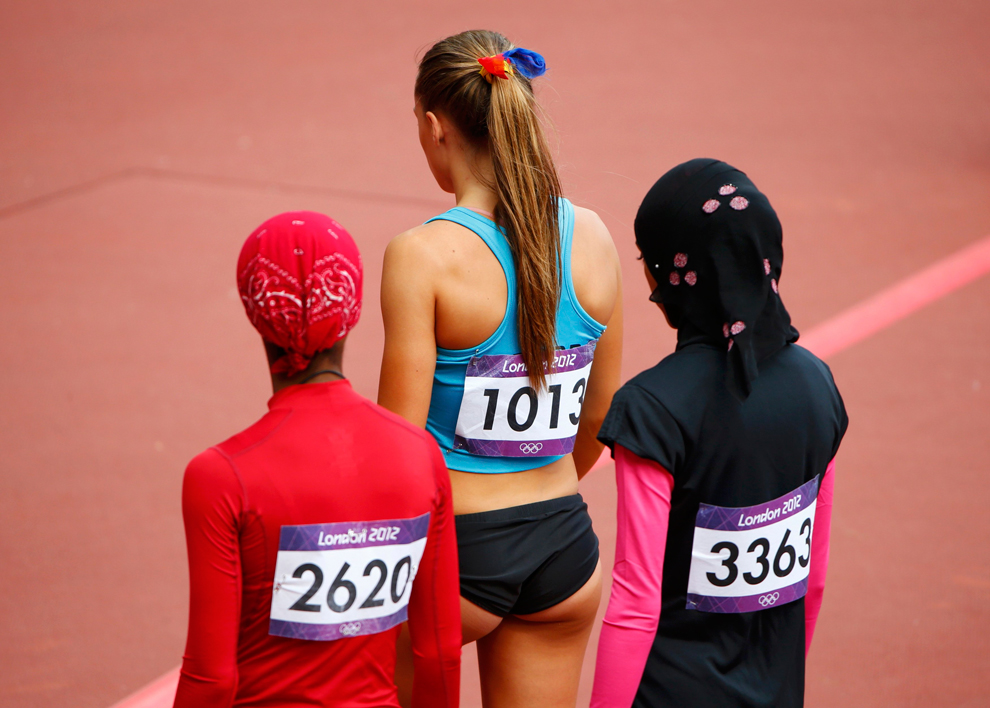
Pic = 1000 wds., or A Cultural/Political Rorschach Test

Since there is still a bit of an Olympic mood wafting about the offices of DI from yesterday's post, let's look at another side of the games: the inevitable juxtaposition of different cultures, politics, and gender roles among the participating nations.  I found a really awesome photo on the Boston Globe's Big Picture blog, that perfectly captures this juxtaposition in a single frame.  This image can be a wonderful mirror to hold up to other people to get a glimpse of their worldview.

So, here's a fun game you can play with your friends and acquaintances.  First, show them the image below, then wait for a reaction.  I'm willing to bet you will get a host of responses that tell you a lot about the cultural and political biases of the observer.  What do you see in this image?  Hit the comments with your reactions if you would like to stir the pot.

Clash of cultures?  An inspiring image of unity? Sexism?  This image is fraught with symbolism.
(source: David Gray/Reuters)

August 6, 2012

We Really Are Living in the Future, or The Real Hero of the Games

You can have your Michael Phelps, your Andy Murray, and your Usain Bolt.  Oscar Pistorius is my new sports idol.  He personifies so many noble human qualities that it's hard to do the real person justice by trying to list them all here.  We'd all be a little better if we behaved more like Oscar.  WWOD?


I won't repeat a lot of what's been said about him already, but we can put to bed the whole myth that he somehow gets an advantage from his prosthetic legs.  Having years of experience designing high-performance sport implements with carbon fiber reinforced materials, as well as a few developing orthopedic braces for athletes, I think I can shed some unique insights on the "controversy" surround his inclusion in the Olympics.

First, despite what marketing execs have led you to believe, carbon fiber composites are not magic.  All that carbon fiber gives you is a very stiff, and a very strong material per unit of mass.  That allows engineers to design structures that are much lighter than their metallic counterparts, and much stronger and stiffer than their plastic counterparts.  From the simplest analytic point of view, Oscar's "legs" would be too heavy to be practical made from an alloy, or too weak make from just plastics.  It is only the combination of properties that composite materials have that allow his high-performance running legs to be fully realized.

The next question is inevitably, does it give him an advantage over biologic legs that most of us are born with.  There really is no simple way to answer that question, but the main point is that they do not.  The blade-like design of his prostheses act like a spring.  They simply store and return the energy that he generates on each stride.  Just like the muscles, tendons, ligaments and bones that he doesn't have would ordinarily.  The only possible advantage that I could imagine would be if he decided to "grow" several inches by ordering longer prostheses that were a little stiffer.  Theoretically, he would have a little more leverage with each stride (just like taller people do), but that raises ethical issues and any self-respecting doctor or prosthetist would refuse to go along.  Plus, he would simply have to train harder to generate more force to effectively load his longer legs anyway.  So, we'll call that a wash, hypothetical though it may be.

On the flip side, however, we can clearly see how he is disadvantaged by his prostheses: no ankle joints.  His blade-like legs only replicate the muscles of the lower leg, foot arch and ball.  While carbon fiber is strong and light, it is only so in one direction.  At present is would be extremely difficult to design a composite structure that mimics the flexibility and strength of the human ankle.  In order to do that we are probably talking about metal and/or plastic components, and we're back to the initial design problem: strength to weight ratio.  If you watched him run you could see he lacked the fluidity and agility of the other runners.  Pistorius' gait is more analogous to someone on stilts rather than a silky smooth world class sprinter.

Finally, we can instantly know the obvious truth that Oscar's legs provide him no advantage.  Just count the number of his competitors that have elected to become amputees to gain the same "advantage".

I don't mean in my explanation to minimize the amazing accomplishment of running world class 400m times as a double amputee.  And shame on the gatekeepers of international athletics for attempting to keep him out of competition for so long.  We have witnessed some remarkable achievements at these games, but none more so than Oscar Pistorius making the semifinals in the 400m sprint.  Here's hoping his team earn a medal in the relay.